Upgrade traditional AHUs with a FanGrid retrofit using ebm-papst EC fans for improved airflow, cooling stability, and reliability.
As manufacturing facilities continue to increase equipment density and production capacity, many existing HVAC and cooling systems are being pushed beyond their original design limits. For facilities relying on aging Air Handling Units (AHUs), maintaining stable airflow and cooling performance under varying operating conditions can become increasingly difficult.
A leading electronics R&D and manufacturing company in Sichuan recently encountered this challenge. Its existing AHU system, equipped with traditional fan technology, was no longer able to provide the level of airflow control and cooling stability required by the facility's growing thermal load.
Challenges of the Existing AHU System
Although the AHU remained operational, several performance limitations had become increasingly apparent:
Uneven airflow distribution across the unit
Limited turndown capability under partial-load operation
Reduced cooling stability during fluctuating production demands
Increasing difficulty maintaining consistent environmental conditions
As equipment density increased, the performance margin of the existing system continued to shrink, creating concerns about long-term operational reliability.
A FanGrid Retrofit Instead of Full AHU Replacement
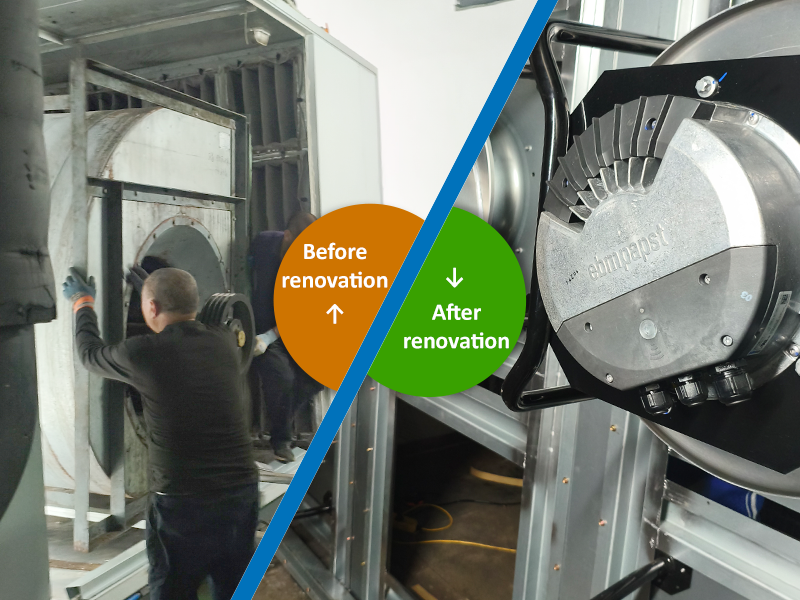
Rather than replacing the entire AHU—a solution that would require significant investment, downtime, and installation work—AISA PACIFIC SHENGRUI LIMITED proposed a targeted retrofit strategy.
The project involved converting the traditional fan section into a modern fan wall configuration using high-efficiency ebm-papst EC fans.
Compared with conventional fan arrangements, a FanGrid system offers several important advantages:
More uniform airflow distribution throughout the AHU
Modular fan operation with flexible speed control
Improved redundancy and system reliability
Enhanced adaptability to changing load conditions
Potential reductions in energy consumption and maintenance requirements
This approach enabled the customer to modernize the existing equipment while preserving the majority of the AHU structure.
Engineering Beyond Fan Replacement
The success of a FanGrid retrofit depends on much more than simply installing new fans.
To ensure optimal system performance, the engineering team at AISA PACIFIC SHENGRUI LIMITED carried out a comprehensive evaluation of the existing AHU and operating environment.
Key engineering activities included:
1. Site-Specific Fan Selection
Fan models were selected based on actual operating conditions rather than catalog specifications alone, ensuring the solution matched the facility's real airflow and pressure requirements.
2. Working Point and Performance Curve Analysis
The team analyzed system resistance and matched fan performance curves to the AHU's actual operating point, helping achieve maximum efficiency and stable airflow performance.
3. FanGrid Layout Optimization
The fan array configuration was carefully designed to fit within the existing AHU enclosure while minimizing airflow interference and maximizing airflow uniformity across the entire system.
These engineering efforts transformed the project from a simple component upgrade into a system-level optimization initiative.
Results After the Retrofit
Following the FanGrid conversion, the facility experienced several noticeable improvements:
More uniform airflow distribution throughout the AHU
Improved cooling stability under varying load conditions
Greater operational flexibility through EC fan speed control
Enhanced system reliability through modular fan redundancy
Extended service life of existing AHU equipment
Reduced need for a complete system replacement
The retrofit successfully addressed the facility's immediate cooling challenges while providing a scalable foundation for future operational demands.
Conclusion
This project demonstrates that effective HVAC modernization is not simply about installing newer equipment. The greatest performance gains often come from selecting the right technology and integrating it through application-focused engineering.
At AISA PACIFIC SHENGRUI LIMITED, we specialize in ventilation and cooling system optimization, combining fan selection expertise with a deep understanding of airflow dynamics, control strategies, and mechanical integration. Our approach extends beyond component replacement to deliver practical, system-level solutions tailored to real operating conditions.
For facilities where traditional AHU systems are struggling to meet evolving performance requirements, a customized FanGrid retrofit can provide a highly effective path toward improved cooling stability, operational flexibility, and long-term reliability.
FAQ
1. What is an AHU FanGrid retrofit?
An AHU FanGrid retrofit is the process of replacing a traditional single-fan or belt-driven fan section inside an Air Handling Unit (AHU) with multiple EC fans arranged in a FanGrid configuration. This upgrade improves airflow distribution, increases operational flexibility, enhances redundancy, and can extend the service life of existing HVAC equipment without requiring a complete AHU replacement.
2. Why are FanGrid systems becoming popular in industrial cooling applications?
FanGrid systems provide more uniform airflow, modular capacity control, and higher system reliability compared with conventional fan arrangements. Because multiple fans operate in parallel, facilities can maintain airflow even if one fan requires maintenance, making FanGrid systems a preferred solution for critical cooling environments such as electronics manufacturing, data centers, and cleanrooms.
3. How do EC fans improve AHU performance?
EC fans combine high-efficiency motors with integrated electronic controls, enabling precise speed regulation and lower energy consumption. In AHU retrofit projects, EC fans help maintain stable airflow across varying load conditions while reducing operating costs and improving cooling system responsiveness.
4. Can an existing AHU be upgraded without replacing the entire unit?
Yes. Many aging Air Handling Units can be modernized through FanGrid retrofits. By upgrading the fan section while retaining the existing AHU structure, facilities can improve airflow performance and cooling stability while avoiding the high costs and downtime associated with complete equipment replacement.
5. What factors should be considered before implementing a FanGrid retrofit?
A successful FanGrid retrofit requires evaluating actual airflow demand, system static pressure, operating load variations, fan performance curves, and available installation space. Proper engineering analysis ensures the selected EC fan array operates at its optimal efficiency point and delivers long-term performance improvements.

