Plan ebm-papst condenser fan speed control for cold weather. Check sensor feedback, minimum speed, stop behavior and recovery for the selected fan.
Cold weather condenser fan control should match airflow to the refrigeration system’s heat rejection requirement while keeping operation within the equipment’s approved limits. Use the system designer’s control target, then check how the selected fan receives its command, operates at low demand and responds when a signal or power supply is interrupted.
APAC FAN supplies ebm-papst axial fans for selection and replacement projects, including W3G800-KU21-05/F01. This 800 mm EC axial fan is a product option to discuss when reviewing an existing installation or a proposed control arrangement. Its full designation must be retained when confirming the supplied configuration.
This guide explains the control decisions to make before commissioning. It does not assign a pressure setpoint, minimum speed or low temperature rating to W3G800-KU21-05/F01; those requirements need confirmation for the exact fan and refrigeration equipment.
Understand why cold weather changes the control requirement
An air cooled condenser transfers heat from the refrigerant to the surrounding air. Changes in outdoor conditions and refrigeration load change the heat rejection requirement and the airflow needed to meet it. Cold ambient air does not mean the refrigeration load has disappeared, particularly where equipment must operate throughout the year.
At low ambient temperatures, excessive condenser heat rejection can allow condensing pressure to fall below the level required by the refrigeration system. The expansion device and compressor operating requirements matter as well as the condenser. The objective is a suitable operating range, rather than the lowest achievable pressure or maximum fan speed.
Use the equipment designer’s limits and control strategy for the refrigerant, compressor and expansion device in use. A generic outdoor temperature threshold cannot establish the correct pressure target for every installation.
Separate fan speed control from refrigeration pressure control
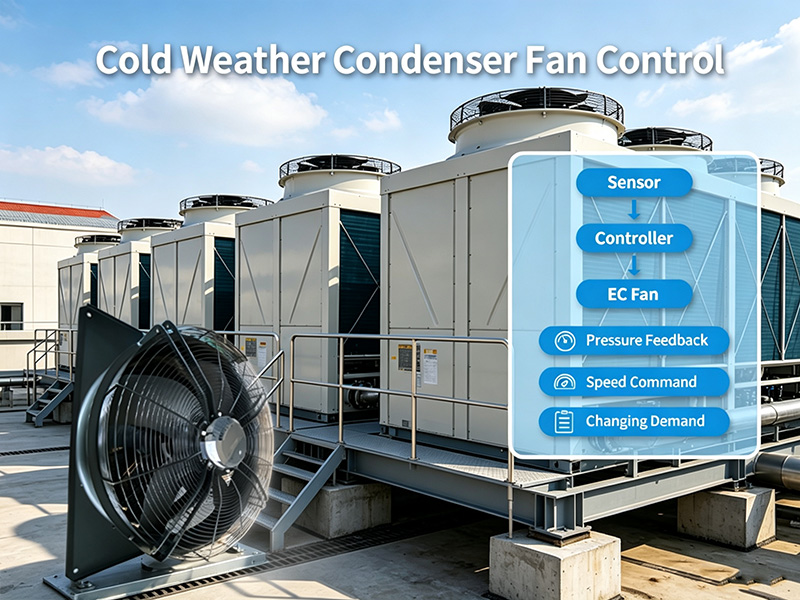
Fan speed control determines the response of the motor to a command. Condensing pressure control uses feedback from the refrigeration system to decide what that command should be. A manually adjusted speed signal may run the fan, but it does not by itself maintain a refrigeration pressure target.
A complete feedback arrangement needs an appropriate sensor, a defined setpoint, a controller and a compatible fan interface. The control function may be provided by the equipment controller or, where specifically supported and configured, by integrated fan electronics. Confirm where each function resides before selecting the components.
ebm-papst offers refrigerant pressure controllers with a 0–10V DC output for compatible EC fan inputs. This illustrates an available control approach, rather than confirmation that such a controller or input is included with W3G800-KU21-05/F01. An integrated PI function, where fitted, also does not establish that a sensor or complete refrigeration control package is supplied.
Compare fan cycling with variable speed operation
Fan cycling changes heat rejection by switching fans on and off. Variable speed operation adjusts the output of running fans more gradually. Either approach must be assessed within the condenser design, including the permitted switching behavior and the control response at low demand.
|
Approach
|
What changes
|
What to assess
|
|
Fan cycling
|
Fans are started and stopped as the control condition changes
|
Pressure fluctuations, switching frequency and the equipment approved start and stop method
|
|
Variable speed
|
The running fan follows a changing command
|
Available speed range, configured response and stability around the target
|
Continuous modulation can help avoid the abrupt changes associated with simple on and off control. It does not establish a fixed energy saving for every installation. Evaluate the complete refrigeration system across its expected operating conditions, rather than comparing fan motor input at unrelated duties.
Confirm the fan control interface
The EC designation alone does not identify a fan’s complete control interface. Across the ebm-papst range, available options include analogue signals, PWM and Modbus, with the supported functions varying by part number. A controller and fan must be matched at the actual input and configuration level.
For W3G800-KU21-05/F01, request confirmation of the supported command input, signal reference, enable function, feedback and alarm outputs. If a communication interface is available, also confirm the relevant parameter specification and the configured command source. Do not select a controller solely because a different W3G800 variant uses it.
Keep the fan power supply separate from its control signal in the design review. A 0–10V command is a control signal, not the mains supply. Do not assume that a controller which varies an AC motor’s supply voltage is suitable for an EC fan. Use the input arrangement approved for the exact product.
Define minimum running speed and stop behavior separately
The lowest command, the lowest permitted running speed and the condition that stops the fan are separate items. A percentage command is meaningful only after its relationship to speed and any configured limits has been established. It should not be treated as an airflow measurement.
Ask the equipment designer to define what should happen when demand falls below the usable modulation range. The intended response may involve a permitted minimum speed, a controlled stop or another equipment specific sequence. Check restart conditions as well as the point at which the fan stops.
Do not apply a universal minimum such as 20 percent, or assume that zero command always means stopped. For W3G800-KU21-05/F01, neither a minimum speed nor a command to stop threshold is established by the product information reviewed for this guide.
Plan cold startup and recovery before commissioning
Review the first start after a cold shutdown, not only operation after the system has warmed up. The refrigeration system may need a defined startup sequence to establish suitable operating conditions. Fan demand during that sequence belongs in the equipment control design.
Agree the response to sensor failure, loss of the command, communication interruption and restoration of power. Check which conditions generate an alarm and how normal control is recovered. Full speed, minimum speed, last command and stop are possible design choices to evaluate; none should be assumed to be the default for this fan.
Record the selected behavior and verify it with the equipment’s approved commissioning procedure. Normal fan modulation must remain coordinated with the refrigeration equipment’s protective functions.
Check low temperature suitability independently
A successful speed control scheme does not establish that a fan is suitable for continuous operation at the lowest site temperature. Confirm the operating temperature range, permitted startup conditions and any required bearing or construction option for the supplied fan.
Do not transfer a low temperature allowance from a similar model or from transport and storage data. For W3G800-KU21-05/F01, the low temperature operating limit remains an exact configuration check. Also assess local snow, ice, water drainage and airflow obstruction in the equipment review without assuming that speed control resolves these conditions.
Verify the control response on the condenser
Commission at representative conditions within the approved operating envelope. Compare the measured control variable with its target, then confirm that fan response follows the intended direction as demand changes. Check for repeated cycling or persistent oscillation before accepting the settings.
Record the sensor reading, command, available fan feedback and relevant refrigeration operating values together. This helps distinguish an incorrect signal from a fan response problem. A speed indication confirms rotational behavior; it does not directly establish airflow through the coil.
If the available weather conditions do not cover the specified coldest duty, document what has been verified and agree how the remaining condition will be assessed. Keep a record of the final configuration for future service or replacement.
Discuss the fan and control requirements with APAC FAN
For a quotation for W3G800-KU21-05/F01, send the full model, quantity and destination to sales@apac-vent.com or use the APAC FAN contact page. If you need help reviewing the control arrangement, include the existing controller details, a fan nameplate photo and the required operating conditions. These details help establish which configuration information needs checking.
Frequently asked questions
Q1: Should condenser fans be switched off whenever the weather is cold?
A1: No. Fan operation should follow the refrigeration system’s demand and approved control sequence. Outdoor temperature alone is not enough to decide when a fan should stop.
Q2: Does an EC fan include a complete condensing pressure control system?
A2: Not necessarily. Confirm the sensor, setpoint source, controller and compatible fan input. Integrated control functions, where available, still require an application specific configuration.
Q3: What minimum speed should I use for W3G800-KU21-05/F01?
A3: No universal value is established here. Confirm the exact fan’s permitted running range and configured command response, then define the low demand behavior with the equipment designer.
Q4: Will the fan run at full speed if the control signal is lost?
A4: Do not assume that response. Verify the exact configuration and the intended fault handling for the complete system, then confirm the behavior during commissioning.

