Compare EC fan brands from APAC FAN by airflow, controls, installation and operating cost. Find the right option for HVAC, cooling and ventilation.
Choosing an EC fan brand is a practical engineering and purchasing decision. The best option is the fan that delivers the required airflow against the actual system resistance, fits the equipment, works with its controls and makes sense over the expected operating period. A familiar brand name or a low initial quotation cannot answer all of those questions.
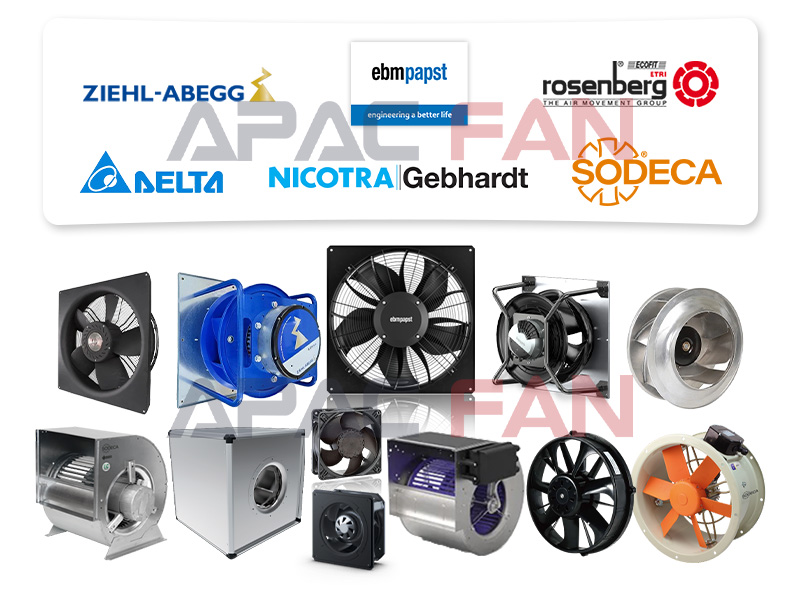
APAC FAN supplies EC fan solutions from ebm-papst, ZIEHL-ABEGG, Delta, Nicotra Gebhardt, Rosenberg and SODECA. These options cover different product formats, from axial fans for heat exchangers to centrifugal fans for air handling and complete extraction units. This guide explains how to compare those choices without treating every product as interchangeable or assigning unsupported price rankings to whole brands.
Key Takeaways
- Start with airflow and pressure together. Maximum airflow alone does not establish whether a fan can perform in your equipment.
- Compare equivalent assemblies. A bare impeller, a bracketed fan module and a complete extraction unit include different components and installation work.
- Evaluate purchase price together with operating power, control integration, installation changes and maintenance access.
- Confirm controls, electrical supply and environmental limits for the complete model number and suffix.
- Use a current quotation for price and delivery. Brand reputation cannot establish the commercial terms for a particular order.
Our Approach to Comparing EC Fan Brands
We supply the brands discussed in this article, so the comparison is written from a supplier and selection-support perspective. It is not an independent laboratory test or a first-to-last ranking. The brand profiles describe relevant product formats and selection questions; they do not claim that one manufacturer is always quieter, more efficient, more reliable or less expensive than another.
The product examples below give buyers concrete starting points. They are not a set of directly competing fans. Their sizes, supply requirements and installation formats differ, and no cross-brand replacement is approved simply because two products appear in the same table. Suitability requires an assessment of the specific equipment and operating point.
EC Fan Brands at a Glance
|
Brand
|
EC formats to consider
|
Main comparison question
|
|
ebm-papst
|
Axial and centrifugal fans
|
Which fan format and curve fit the equipment duty?
|
|
ZIEHL-ABEGG
|
EC centrifugal and axial fans
|
Does the exact variant match the required duty and controls?
|
|
Delta
|
GTW axial, GTB blower and GTM bracketed assemblies
|
Which configuration fits the layout and electrical supply?
|
|
Nicotra Gebhardt
|
ECM centrifugal plug fans
|
Does the plug assembly fit the fan chamber and inlet arrangement?
|
|
Rosenberg
|
EC fans with integrated electronics
|
Which exact EC variant meets the project requirements?
|
|
SODECA
|
EC extraction units, centrifugal and roof fans
|
Is an integrated ventilation unit required?
|
Availability depends on the selected model, quantity and delivery destination. Review the exact fan specification and current supply terms before placing an order.
What Premium and Value Mean in an EC Fan Project
The terms premium and value are most useful when they describe the outcome of a project comparison. A premium-priced option may be worthwhile when its documented performance, installation format or control functions reduce other costs. A value-focused option may be the better purchase when it satisfies the same essential requirements with a lower total installed and operating cost.
Those conclusions must come from comparable model data and quotations. They should not be assigned to every product carrying a particular brand name. A small fan from one manufacturer and a large high-pressure fan from another do not establish a meaningful price comparison. Neither does a comparison between an unmounted fan and a complete acoustic extraction unit.
When a Higher Initial Price Can Be Justified
A higher initial price can be justified if the selected fan reduces installation changes, meets an acoustic requirement that alternatives cannot meet, or uses less electrical input at the same operating points. In an existing AHU, retaining suitable mounting interfaces and control connections may also reduce commissioning work. These benefits should be checked and costed, rather than assumed from the brand.
For equipment operating many hours each year, even a modest verified difference in input power deserves attention. Its commercial importance depends on the operating schedule, electricity tariff and assessment period. For standby or occasional operation, installation cost, compatibility and access to a replacement may carry more weight.
When a Value Focused Option Makes Sense
A value-focused purchase starts with a specification that defines what the equipment actually needs. If several candidates satisfy that specification, compare their installed cost, power consumption over the load profile and supply terms. Features that the equipment will never use do not automatically add value to the purchase.
For OEM projects, assess sample performance in the intended enclosure before committing to production quantities. Include wiring, commissioning, packaging requirements and consistency of the exact ordered configuration in the evaluation. A favorable unit price is useful only if the fan can be integrated into the finished equipment successfully.
|
Comparison
|
Evidence needed before choosing
|
|
Purchase price
|
Current quotations for equivalent duty and scope of supply.
|
|
Operating cost
|
Electrical input at the same operating points and annual hours.
|
|
Controls
|
Exact signal, communication, monitoring and accessory requirements.
|
|
Installation
|
Drawing, mounting, inlet components and cost of changes.
|
|
Support and supply
|
Written order-specific lead time, warranty and replacement terms.
|
Brand Profiles
ebm-papst
ebm-papst is a starting point for buyers comparing EC axial and centrifugal fan options for HVAC and cooling equipment. Our EC axial range supports searches for heat-exchanger and ventilation fans, while our data-center selection includes centrifugal fan families such as RadiPac and RadiCal and axial solutions such as AxiBlade.
For an AHU or precision-cooling project, begin with the fan format, required pressure and installation envelope. For an outdoor heat exchanger, begin with the coil duty, airflow direction, mounting and environmental conditions. Family names help narrow the search, but the final selection still requires the exact product curve, drawing and electrical documentation.
Keep the full order code when replacing an existing fan. A matching diameter or a similar model prefix does not establish equivalent wiring or mechanical fit. Where an existing installation already uses ebm-papst fans, compare a like-for-like replacement with a proposed upgrade before deciding whether changes to the mounting or controls are justified.
ZIEHL-ABEGG
ZIEHL-ABEGG provides another route for EC centrifugal and axial fan selection. Our range includes an EC centrifugal category and specific EC axial products such as FN091-ZIQ.GL.V5P1 180713. These give buyers options to investigate for air handling and heat-exchanger projects, subject to the equipment requirements.
ECblue is relevant when evaluating the motor and controls. ZIEHL-ABEGG describes control arrangements using 0–10V or MODBUS depending on the version. Check the interface supplied with the exact fan, including any required control module, rather than expecting every ECblue product to have the same connections.
For replacement work, retain both the complete type designation and article number. Compare the mounting arrangement, operating curve, supply and control documentation with the installed unit. If a different fan arrangement is proposed, include the inlet conditions and commissioning requirements in the review before approving the change.
Delta
Delta EC options include GTW axial fans, GTB centrifugal blowers and GTM bracketed centrifugal assemblies. Our Delta EC selection page presents these formats for HVAC, precision cooling, industrial equipment and related cooling applications. Choose the format around the equipment layout and duty requirements before comparing individual sizes.
Delta also offers a separate DC cooling-fan range. A DC compact fan and an AC-input EC fan should be evaluated according to their actual supply and installation requirements; similar control terminology does not make them equivalent replacements. Delta’s own EC catalogue distinguishes axial and centrifugal product formats.
For an alternative-brand proposal, ask for the exact Delta model and configuration, its curve at the required operating points and the relevant drawing and wiring information. Then obtain comparable quotations. Delta should be evaluated on the submitted product data and commercial terms, without assuming that the brand is always the lowest-price option.
Nicotra Gebhardt
Nicotra Gebhardt is relevant to buyers evaluating centrifugal plug-fan arrangements. PA-C50-LM56-C0000 is one example in our range with its electrical type identified as ECM, a 500mm nominal impeller diameter and a three-phase supply range of 380–480V. It provides a concrete starting point for a project requiring a centrifugal plug format.
The plug-fan arrangement needs to be assessed as part of the equipment. Check the inlet geometry, available chamber space, mounting orientation and service access alongside the performance curve. An existing fan chamber can affect how easily a proposed replacement can be installed and how it performs after commissioning.
Keep the complete PA-C order code when requesting a comparison. Different impeller sizes and motor configurations should not be grouped together as a single performance level. For a quotation, specify whether the requirement is for the fan alone or a package that includes the mounting and inlet components needed for the installation.
Rosenberg
Our Rosenberg offering includes EC technology with integrated control electronics. This makes Rosenberg relevant to an initial comparison for ventilation and air-handling projects. The selected EC version must be identified clearly because the wider Rosenberg range also contains AC products.
The manufacturer distinguishes EC plug-fan types from AC plug-fan types. For example, its plug-fan information identifies GKHR, GKHM and GKHS as EC types, while DKHR and DKHM are AC types. This distinction matters when evaluating an existing fan nameplate or a proposed replacement.
For a project enquiry, define the airflow, pressure, supply, installation envelope and control requirement first. Ask for an exact EC selection and its documentation before comparing cost or compatibility. A general brand match is useful for starting the conversation, but a confirmed order code is needed for procurement.
SODECA
SODECA adds complete ventilation and extraction formats to the comparison. Our range includes CJLINE/EC air-extraction units with a linear inlet and outlet, CPV/EC-1325-4M-0.5 IE5 centrifugal fans and CVT/EC roof-extraction products. These differ from a bare fan intended to be integrated into an OEM enclosure.
CJLINE/EC-1131-4M-0.33 IE5 is an example of a complete EC extraction unit. For a ducted installation, assess its connection arrangement, available access and performance against the duct-system resistance. For roof-mounted equipment, assess the discharge direction and the mounting interface as well as the fan duty.
Where a smoke-extraction function is required, select the exact approved configuration and check its certificates and operating instructions against the project specification. An EC designation alone does not establish a smoke-extraction rating or approval for a hazardous atmosphere. Keep the normal ventilation requirement and any emergency operating requirement explicit in the selection enquiry.
Product Examples to Start a Selection Enquiry
These examples illustrate different supply and installation formats. The listed dimensions and electrical information do not replace a duty-point selection. Maximum airflow and maximum pressure, where provided in a product specification, must not be assumed to occur simultaneously.
How to Compare EC Fans Fairly
Match Airflow and Pressure at the Same Operating Point
Define the airflow required by the equipment and the pressure the fan must overcome. Include resistance from filters, coils, grilles, ductwork and other components in the system assessment. Ask for the proposed fan’s operating point on its curve and the corresponding electrical input.
If the equipment has changing demand, specify several operating conditions. A fan selected only for the peak condition may spend much of its life elsewhere on the curve. Include the expected hours at each condition so the comparison reflects the way the system will actually operate.
Compare Equivalent Assemblies and Installation Work
Identify what each offer includes: the impeller and motor, inlet nozzle, bracket, guard, mounting frame, enclosure or control accessories. A lower-priced component may require additional work before it becomes a usable installation. A more complete assembly may include parts that the existing equipment already provides.
For a retrofit, check access through service doors and the space needed to remove the fan later. Confirm the load carried by the support structure and the clearance around the inlet. Price the required mechanical changes and commissioning work with the fan so the installed-cost comparison remains meaningful.
Check Electrical Supply and Control Behavior
Match the voltage range, phase and frequency to the available supply. Then check the control signal, terminal arrangement and any monitoring outputs. A fan supporting 0–10V control is not automatically ready to replace a unit using a digital communication network.
Define what should happen during startup, a missing command signal, a communication fault and an alarm. For multiple-fan systems, confirm how each fan is addressed, monitored and isolated for service. These are requirements to verify for the selected configuration; they are not universal features of every EC fan.
Compare Acoustic Data Under Equivalent Conditions
Before choosing a fan on noise, identify whether the supplied figure is sound power or sound pressure. For sound-pressure data, check the measurement distance and installation conditions. Also check the operating speed and duty point associated with the published figure.
Installed noise can be influenced by the enclosure, inlet obstructions and the connected airflow path. Where acoustics are critical, request suitable model data and consider verification in the intended equipment. A single catalogue dB figure cannot establish which brand will be quietest in every installation.
Verify Environmental Limits and Documentation
Check the permitted ambient and conveyed-air temperatures, ingress protection, installation position and any moisture-related restrictions. Outdoor use, low-temperature operation and exposure to contamination require a review of the exact product instructions.
Request the current datasheet, dimensional drawing, wiring diagram and operating instructions. Where the project requires a declaration or approval document, verify its scope for the ordered product. A document relating to a motor, accessory or different variant may not establish compliance for the complete assembly being purchased.
Calculate Operating Cost Across the Load Profile
Annual energy use is calculated by multiplying the electrical input at each operating condition by the hours spent at that condition, then adding the results. Use input power in kW to obtain energy in kWh. Multiply that energy by the applicable electricity tariff to calculate the corresponding energy cost.
For a changing load, use several operating conditions rather than multiplying the maximum rated input by all annual hours. Apply the same airflow and pressure requirements to every candidate. If one fan delivers more air than required, comparing its power directly with a correctly controlled alternative does not provide an equivalent result.
Add the purchase price, installation, control changes and commissioning costs over a common assessment period. Include maintenance costs only where there is a reasonable basis for estimating them. A whole-life comparison can inform the choice, but it should not hide uncertain assumptions behind a precise savings percentage.
For an upgrade, simple payback divides the additional installed investment by the estimated annual net operating savings. If annual savings are not established, a credible payback period cannot be stated. Where continuity of operation matters, assess the service and replacement arrangements separately instead of inventing a monetary downtime allowance.
For a detailed comparison of energy use, operating costs and payback, read our EC Fans vs AC Fans guide.
Which Options Should You Compare for Your Application
|
Application
|
Brands and formats to investigate
|
First selection priority
|
|
AHU and precision cooling
|
ebm-papst, ZIEHL-ABEGG, Delta, Nicotra Gebhardt; Rosenberg EC selection
|
Pressure duty, fan chamber, inlet and controls
|
|
Condensers and heat exchangers
|
ebm-papst, ZIEHL-ABEGG and Delta EC axial options
|
Airflow through the coil and mounting arrangement
|
|
Ducted extraction
|
SODECA EC extraction units
|
Duct resistance, connections and access
|
|
Roof extraction
|
SODECA CVT/EC range
|
Discharge arrangement, roof interface and specified approvals
|
|
Existing fan replacement
|
Original-brand replacement and technically suitable alternatives
|
Full model identity, curve, wiring and fit
|
The brands shown are starting points based on the product formats discussed above. They are not rankings or assurances that every product from those brands meets the application. A complete extraction unit, for example, may suit a ducted project while being unsuitable for installation inside an existing AHU fan chamber.
For a constrained retrofit, begin with the installed fan’s complete identification and the available space. For new equipment, begin with the design airflow, resistance, supply and control architecture. In both cases, reduce the shortlist only after confirming those requirements.
What to Confirm Before Ordering
|
Information
|
What to establish
|
|
Duty
|
Required airflow and pressure, plus normal and peak conditions.
|
|
Electrical supply
|
Voltage range, phase, frequency and connection requirements.
|
|
Mechanical fit
|
Overall dimensions, mounting, inlet clearance and airflow direction.
|
|
Controls
|
Command signal, monitoring, communication and required accessories.
|
|
Environment
|
Temperature limits, moisture exposure, ingress protection and orientation.
|
|
Acoustics
|
Comparable sound data at the intended operating condition.
|
|
Documentation
|
Current datasheet, drawing, instructions and required declarations.
|
|
Commercial terms
|
Exact model, quantity, scope, delivery, warranty and quotation validity.
|
For an existing fan, send a clear nameplate photograph and the complete model number, including suffixes and article numbers. Photographs of the mounting and electrical connections help explain the installation, while the original wiring diagram and equipment requirements provide a stronger basis for checking compatibility.
Frequently Asked Questions
Q1: Which EC fan brand is best for HVAC
A1: The best choice depends on airflow, pressure, installation space, controls and operating conditions. Start with suitable product formats from the brands above, then compare exact models at the required duty. No brand can be selected responsibly from its name alone.
Q2: Is Delta always cheaper than ebm-papst or ZIEHL-ABEGG
A2: A reliable price comparison requires current quotations for technically suitable models, quantities and delivery terms. Different sizes and assembly formats can produce large price differences. We do not assign a fixed price order to these brands.
Q3: Does a higher priced EC fan always use less energy
A3: Purchase price does not establish operating efficiency. Compare electrical input while delivering the same airflow at the same pressure, then account for the annual load profile. Installation and control settings also need to support the intended operation.
Q4: Can an EC fan replace an AC fan from another brand
A4: A replacement may be possible after checking performance, mechanical fit, electrical supply and control requirements. Some projects require mounting changes or new controls. A shared diameter or similar maximum airflow is not sufficient to confirm compatibility.
Q5: Do all EC fans support MODBUS
A5: No. Control and communication options depend on the exact product and version. Confirm the wiring information and any required accessory before ordering. An EC motor designation does not by itself specify the communication interface.
Q6: Which brand makes the quietest EC fans
A6: Compare suitable models under equivalent acoustic test and operating conditions. Sound power and sound pressure figures cannot be treated as interchangeable, and installation conditions affect the result. We do not name a quietest brand without comparable evidence.
Q7: Is a compact DC fan interchangeable with an EC ventilation fan
A7: Both can use electronic commutation, but commercial DC and EC product categories may have different supply and installation requirements. Check the actual input voltage, fan curve, dimensions and control arrangement. The motor principle alone does not establish interchangeability.
Q8: Can a lower priced fan be suitable for continuous operation
A8: Price alone cannot answer that question. Check the selected product’s operating limits, documentation and suitability for the duty, together with energy use and the replacement plan. Avoid assuming a fixed lifetime or reliability level from a brand or price category.
Q9: Can one brand be used throughout a fan array
A9: A fan array needs a system-level selection covering airflow, pressure, controls, monitoring and service access. If continued operation after a fan failure is required, verify the remaining fans’ capability and the behavior of the failed branch. Multiple fans alone do not establish a defined redundancy level.
About APAC FAN
APAC FAN supplies industrial fans, blowers and cooling solutions through our official website apacfan.com or online shopping mall sr-vent.com. We help customers review product options and replacement requirements for HVAC, refrigeration, data centers, energy storage and industrial equipment. International delivery and selection support are available, with product and order details confirmed for each enquiry.
Send your fan model or project requirements to sales@apac-vent.com, or browse the relevant product pages. Include the quantity, delivery destination and required schedule. Please leave an email address, WhatsApp number or phone number so we can reply with the selection information, price and lead time for your requirements.

