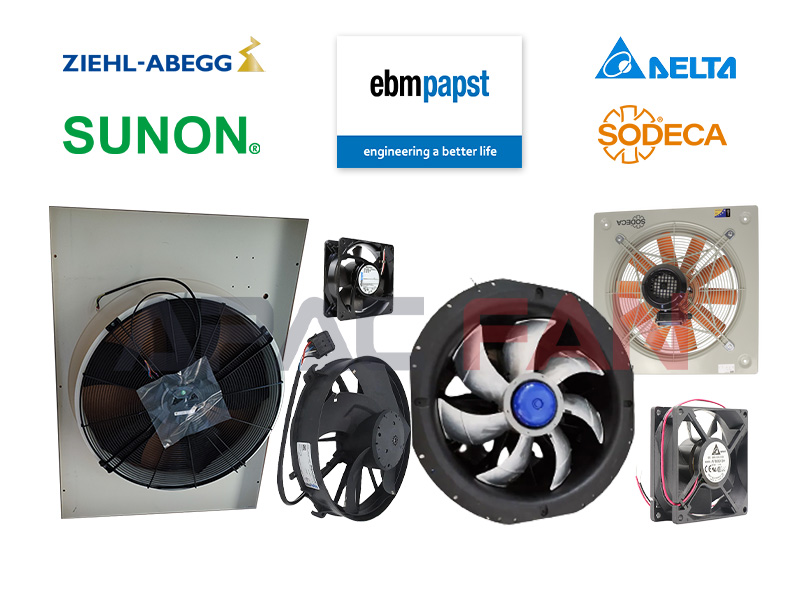
Compare axial fans from ebm-papst, ZIEHL-ABEGG, Delta, SUNON and SODECA. Explore model data and ask APAC FAN for selection and replacement support.
Axial fans move air along the impeller axis and generally suit high airflow at relatively low static pressure. Applications include equipment cooling, wall exhaust and HVAC heat exchangers when the fan matches the system resistance. APAC FAN supplies axial fans from ebm-papst, ZIEHL-ABEGG, Delta, SUNON and SODECA, with model matching and selection support for buyers evaluating new equipment or replacement requirements in the USA.
This guide brings compact equipment fans and larger ventilation fans into one comparison. They serve different duties: a compact cabinet fan is not a complete warehouse exhaust assembly, and an impeller without a housing is not automatically a wall or roof fan. Start with the required operating point and installation arrangement, then check the exact electrical version.
What performance ranges do the listed axial fans cover
The figures below describe selected listings in this article, rather than the limits of the complete APAC FAN supply range. Listed performance must be checked against the manufacturer curve for the exact voltage, frequency and configuration before final selection.
- Maximum airflow entries: approximately 15.4–19,423.1 CFM, converted from 26.18–33,000 m³/h. These are listing maxima, not delivered airflow at a specified system pressure.
- Listed maximum pressure: available entries reach 1,050Pa, approximately 4.215 in H₂O. The website does not consistently identify whether each pressure entry is static or total; request the applicable curve.
- Electrical options in the comparison: 12V DC, 24V DC and 27.5V DC; AC listings include 230V, 400V and three-phase 380–480V. Some entries need electrical clarification.
- Motor technologies: AC, DC and EC. The Delta GTW071PUT24E-M001 listing is placed in the EC fan category.
- Size examples: 40*40*28mm compact frames through a listed 910mm fan size. Dimensions may describe a frame, assembly or nominal fan diameter; compare drawings.
- Published sound entries: 40–82dB where provided. Test distance, weighting and sound pressure versus sound power are not consistently stated, so these entries cannot be used as a quietest-fan ranking.
Which axial fan models should you compare
Use the linked product pages to review the original specifications. CFM values are rounded conversions using 1m³/h ≈ 0.588578 CFM; pressure conversions use 1 in H₂O ≈ 249.089Pa. The pressure column reports the listing’s maximum pressure in Pa and its equivalent in inches of water (in H₂O), without reclassifying it as verified static pressure. Noise values retain the listing’s dB notation.
Maximum airflow and maximum pressure are separate endpoints or separately listed limits. Do not read a row as a guarantee that both occur simultaneously. For US AC installations, verify 60Hz ratings, actual supply voltage, phase and applicable equipment approval; a 50Hz or 400V listing is not automatically suitable for a US circuit.
|
Brand
|
Model and product link
|
Fan Type
|
Airflow CFM
|
Max pressure* Pa / in H₂O
|
Voltage V
|
Size mm
|
Noise dB
|
|
ebm-papst
|
4414/2N-522
|
DC axial fan
|
120.7
|
118 / 0.474
|
24 DC
|
119*119*38
|
46
|
|
ebm-papst
|
6314/2TDH4P
|
DC axial fan
|
545.6
|
1050 / 4.215
|
24 DC
|
φ172*51
|
N/A
|
|
ebm-papst
|
4184N/17X
|
DC axial fan
|
98.9
|
N/A
|
24 DC
|
N/A
|
N/A
|
|
ebm-papst
|
W3G300-ER38-45
|
EC axial fan
|
1,183.0
|
243 / 0.976
|
27.5 DC
|
300
|
N/A
|
|
ebm-papst
|
W3G800-GO84-01/F05
|
EC axial fan
|
10,876.9
|
110 / 0.442
|
400 AC
|
800
|
43
|
|
ebm-papst
|
4656N
|
AC axial fan
|
94.2
|
82 / 0.329
|
230 AC
|
119*119*38
|
47
|
|
ebm-papst
|
5656S
|
AC axial fan
|
141.3
|
N/A
|
230 AC
|
135*135*38
|
N/A
|
|
ebm-papst
|
8556N
|
AC axial fan
|
27.1
|
N/A
|
230 AC
|
80*80*38
|
N/A
|
|
ebm-papst
|
W2S130-AA03-01
|
AC axial fan
|
200.1
|
59 / 0.237
|
230 AC
|
172*150*55
|
N/A
|
|
ebm-papst
|
W2E142-BB01-01
|
AC axial fan
|
188.3
|
50 / 0.201
|
230 AC
|
φ150*38
|
N/A
|
|
ebm-papst
|
W2E200-HK38-01
|
AC axial fan
|
517.9
|
95 / 0.381
|
230 AC
|
225*225*80
|
61
|
|
ebm-papst
|
A2E200-AF02-01
|
AC axial fan
|
435.5
|
88 / 0.353
|
230 AC
|
200
|
N/A
|
|
ebm-papst
|
A2E250-AE65-01
|
AC axial fan
|
947.6
|
100 / 0.401
|
230 AC
|
250
|
N/A
|
|
ebm-papst
|
A4E300-AS72-01
|
AC axial fan
|
1,218.4
|
70 / 0.281
|
230 AC
|
300
|
56
|
|
ebm-papst
|
S2D300-AP02-30
|
AC axial fan
|
1,845.2
|
160 / 0.642
|
400 AC
|
300
|
70
|
|
ZIEHL-ABEGG
|
ZN080-ZIL.GL.V7P3 180812
|
EC axial fan
|
16,185.9
|
320 / 1.285
|
3~380-480 AC
|
800
|
N/A
|
|
ZIEHL-ABEGG
|
ZN091-ZIL.GL.V5P1 185822
|
EC axial fan
|
19,423.1
|
325 / 1.305
|
400 AC
|
910
|
N/A
|
|
ZIEHL-ABEGG
|
FB063-6EK.4I.V4P 101680
|
AC axial fan
|
N/A
|
150 / 0.602
|
230 AC
|
630
|
N/A
|
|
ZIEHL-ABEGG
|
FN080-SDQ.6N.V7P5 168786
|
AC axial fan
|
13,243.0
|
153 / 0.614
|
3~400 AC
50Hz†
|
800
|
N/A
|
|
ZIEHL-ABEGG
|
FC091-SDS.7Q.V7 107146
|
AC axial fan
|
N/A
|
N/A
|
400 AC
|
910
|
N/A
|
|
Delta
|
AFB0824SH
|
DC axial fan
|
46.5
|
N/A
|
24 DC
|
80*80*25
|
40
|
|
Delta
|
AFB1224SHE
|
DC axial fan
|
151.9
|
142.23 / 0.571†
|
24 DC
|
120*120*38
|
53
|
|
Delta
|
GTW071PUT24E-M001
|
EC axial fan
|
13,616.2
|
259 / 1.040
|
3~380-480 AC
|
850*850*243
|
82
|
|
SUNON
|
A2175-HBL.TC.GN
|
AC axial fan
|
239.0
|
171.87 / 0.690
|
N/A†
|
171*151*51
|
58
|
|
SUNON
|
PF40281B3-1000U-A9H
|
DC axial fan
|
15.4
|
N/A
|
12 DC
|
40*40*28
|
43.9
|
|
SODECA
|
HC-25-4M/H
|
AC axial fan
|
765.2
|
N/A
|
230/400† AC
|
360*360*280
|
51
|
|
SODECA
|
HC-31-4T/H
|
AC axial fan
|
1,412.6
|
N/A
|
230/400† AC
|
440*440*300
|
54
|
The Fan Type column distinguishes AC axial fan, DC axial fan and EC axial fan technology. EC refers to electronic commutation, not necessarily an AC supply: W3G300-ER38-45 is described as an EC axial fan with a brushless DC motor and a 27.5V DC supply. Follow the exact datasheet for supply and control requirements.
The selected ebm-papst range includes AC and DC compact axial fans as well as larger EC axial fans. Consider 4656N, 5656S and 8556N for compact equipment layouts; review W2S and W2E assemblies against the enclosure drawing, and A2E, A4E and S2D units against the required impeller, mounting and guard arrangement. These are selection starting points, not confirmed interchangeability recommendations.
The selected ZIEHL-ABEGG models include AC axial fans and EC axial fans from the ZN family. FN080-SDQ.6N.V7P5 168786 has a published 50Hz electrical entry, so its listed performance should not be carried over to a 60Hz installation without an approved rating.
AFB0824SH and AFB1224SHE are compact DC axial fans; GTW071PUT24E-M001 is a substantially larger fan listed in the EC axial category. Compare the AFB models for equipment cooling and the GTW assembly for larger air-moving duties only after checking its curve, control interface and installation drawing.
The SUNON examples cover an AC equipment fan and a small DC axial fan. The A2175-HBL.TC.GN page identifies cabinet, telecom and power-supply ventilation applications; PF40281B3-1000U-A9H is a compact component whose suitability depends on the equipment’s thermal and airflow requirements.
SODECA’s sr-vent brand page identifies the HC family as wall-mounted axial fans and also lists tubular and roof ventilation families. The two HC entries above provide wall-ventilation options to investigate; roof or duct installations require the corresponding assembly and performance selection.
What should you consider when selecting an axial fan
How much airflow does the application require
For general room ventilation, a starting calculation is CFM = room volume in cubic feet × required air changes per hour ÷ 60. The air-change target must come from the process, occupancy, applicable design requirements or responsible engineer; it is not a universal number. Make-up air and the exhaust path must support the intended flow.
Equipment cooling needs a thermal and airflow assessment rather than a room air-change target. Provide the heat load, allowable temperature rise and obstructions where available. A high free-air CFM value alone does not show whether the fan will cool the equipment effectively.
What resistance must the fan overcome
Identify losses through filters, coils, louvers, guards, ducts and bends, and state the required airflow with the corresponding static pressure. Ask for the exact performance curve and check that the required point lies within the permitted operating range. Highly restrictive ductwork may call for another fan design; choose from the curve rather than a general label.
Will the fan tolerate the environment and mounting arrangement
Check ambient and air-stream temperatures, moisture, dust and corrosion exposure. Confirm the protection rating for the exact assembly and mounting position. Ordinary ventilation fans should not be assumed suitable for explosive atmospheres or emergency smoke extraction.
For wall mounting, verify the panel opening, guard, louver and weather arrangement. For roof mounting, assess the complete roof unit, curb interface and weather protection; for duct mounting, check flanges, casing, access and inlet conditions. In a cabinet, confirm depth, hole spacing, connector access and clearance around the impeller.
Which motor and controls fit the electrical system
Match AC voltage, frequency and phase to the available circuit. For DC fans, match voltage, polarity and current capacity, and confirm the connector pinout. For EC fans, check the specified supply and speed-command interface; do not assume every EC model has the same controls.
A suitable EC fan may reduce electricity use when efficient operation and demand-based speed control match the application. Compare measured or documented input power at the same airflow and pressure, along with annual operating hours and control behavior. A specific percentage saving or payback cannot be established from motor type alone.
For more detail, read our EC Fans vs AC Fans cost efficiency and payback guide
How should noise and physical size be compared
Compare sound values only when weighting, test distance, mounting conditions and operating point are equivalent. Check the installation drawing as well as the nominal diameter: the listed size may include the frame or complete assembly. Guards and nearby obstructions can alter both noise and airflow after installation.
For a greenhouse, describe moisture exposure, louvers and the intended ventilation duty. For a workshop, identify heat sources, airborne contaminants and any local extraction requirement. For a warehouse, state the occupied area, make-up air route and exhaust arrangement; a general circulation fan does not by itself establish a compliant ventilation rate.
Send the application details through APAC FAN technical enquiries
How do I source replacement axial fans
A replacement enquiry starts with the complete model code, including every suffix and article number. Two fans with the same diameter can differ in voltage, motor winding, speed, airflow direction, connection or protection. Cross-brand replacement requires a full electrical, mechanical and performance comparison.
- Photograph the original nameplate, wiring label, connector and mounting arrangement. Record the full part number, voltage, frequency, phase, rated current or power, and installation dimensions.
- Send the required airflow and static pressure if known, together with the application, operating environment, control method, quantity and US delivery ZIP code. If the duty is unknown, explain how the original equipment operates and which information is available.
- APAC FAN can help review the model identification and available product information, check candidate specifications and discuss quotation availability. State whether an exact replacement is required or whether alternatives may be evaluated.
- Review the proposed part number, drawings, electrical configuration, operating point and commercial terms before ordering. Arrange installation and commissioning through appropriately qualified personnel.
The suitability of a replacement remains dependent on the equipment requirements and exact product configuration. Model matching is not a promise that a different fan is a drop-in substitute.
Why choose APAC FAN as your axial fan distributor
APAC FAN is the brand name of ASIA PACIFIC SHENGRUI LIMITED. Our product offering brings multiple fan brands into one sourcing enquiry, helping buyers compare listed models and organize the information needed for selection or replacement.
The linked product pages make the comparison traceable to individual listings. Our enquiry process lets you provide the exact model, application and quantity so that availability and commercial terms can be checked for your order. Confirm the delivery location and required date when requesting a quotation.
Ask which product documents, nameplate information and manufacturer identification are available for the quoted item. For new equipment or a replacement, discuss technical questions before purchase and retain the confirmed part number and documentation for subsequent support.
Learn more about APAC FAN
Frequently asked questions about axial fans
Q1. What is the difference between axial and centrifugal fans
A1. Axial fans move air principally along the impeller axis and commonly suit high airflow at relatively low resistance. Centrifugal fans turn the flow through an impeller and are often selected for systems with greater pressure losses. Choose using the required airflow and system pressure rather than assuming either design is always preferable.
Q2. Are EC axial fans worth the higher upfront cost
A2. An EC axial fan can be worthwhile when its efficiency and speed control reduce input power over the actual operating schedule. Compare the complete alternatives at the same airflow and pressure, then account for purchase cost, controls and operating hours. No fixed saving percentage applies to every retrofit.
Q3. Can an axial fan replace my existing wall exhaust fan or ebm-papst or Delta unit
A3. An exact replacement may be possible when the complete model code and electrical configuration match. An alternative requires checks of the performance curve, dimensions, mounting, airflow direction, connector and controls. A bare fan component may also require an appropriate housing, guard or weather arrangement.
Q4. How do I choose between AC DC and EC axial fans
A4. Start with the available supply and the equipment control requirements. AC fans need the correct voltage, phase and frequency; DC fans require the correct DC supply and polarity; EC fans require compatible power and control interfaces. Compare performance and input power at the intended duty before choosing a technology.
Q5. Which axial fan is quietest for commercial ventilation
A5. There is no single quietest choice across different airflow duties and installation conditions. Compare acoustic data at equivalent operating points, with the same weighting and test basis, and consider how louvers, guards and ductwork affect the installed sound. The mixed listing values in this article should not be treated as a brand noise ranking.
Q6. Do you supply axial fans in bulk or for OEM projects
A6. Send APAC FAN the model list, quantities, intended equipment application and delivery schedule for a bulk or OEM enquiry. Quotations, availability and project suitability are confirmed for the requested parts and quantities. Contact APAC FAN to discuss the requested quantities and delivery requirements.
Q7. Are the listed AC axial fans ready for US 60Hz installations
A7. The comparison includes listings with incomplete frequency data and a ZIEHL-ABEGG entry expressly rated at 50Hz. Confirm manufacturer-approved voltage, phase, frequency and performance for the exact supplied version, plus any approvals required by the equipment specification. Do not treat a matching nominal voltage as sufficient evidence of compatibility.
Q8. Do maximum airflow and maximum pressure occur together
A8. No: maximum airflow and maximum pressure normally describe different points or limits, rather than a simultaneous duty. Delivered airflow is determined by the fan curve and system resistance. Ask for the curve at the intended supply and speed before approving a selection.
Request an axial fan selection or replacement review
Send your full model number or required airflow and static pressure to APAC FAN. Include voltage, AC frequency and phase or DC requirements, application, quantity, installation dimensions and delivery ZIP code. Nameplate photographs and the original fan curve help make the enquiry more precise.
Request axial fan selection support
Recommended enquiry details: model or requirement; airflow in CFM or m³/h; static pressure in in H₂O or Pa; voltage and frequency; application; quantity; dimensions; control requirements; US delivery ZIP code; requested delivery date.

